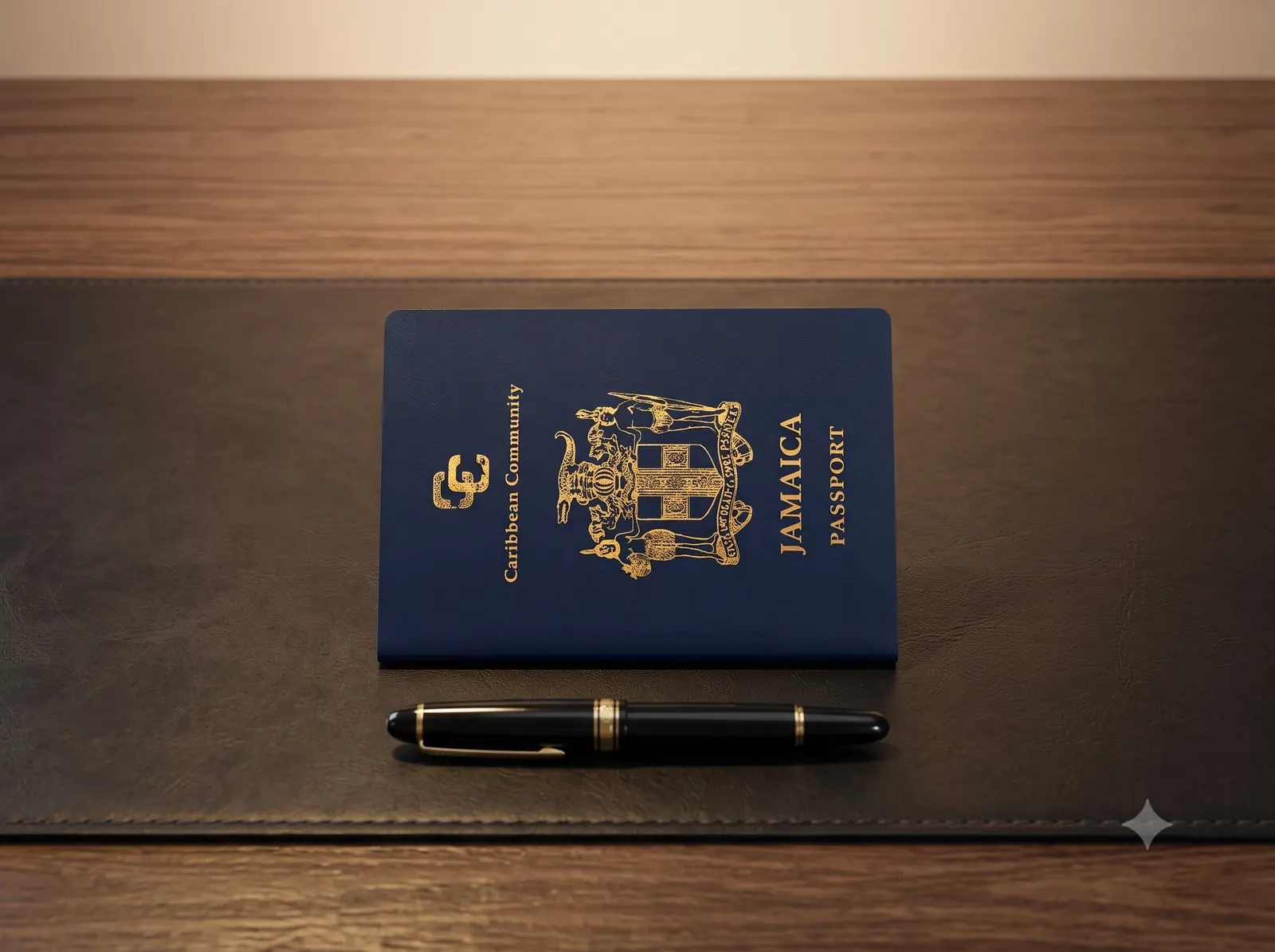
How to Apply for a US Visitor Visa from Jamaica (B1/B2)
The US visitor visa is the one most Jamaicans apply for, and you can do every step yourself. Here is the official process in plain language, what it costs, what to bring to the Embassy in Kingston, and the red flags to watch for if you pay someone to help.
At a glance
- The visaB1/B2, for visits and business trips
- Application feeUS$185 each, not refundable
- The formDS-160, online and free to fill in
- Biggest red flagA “guaranteed” visa
- InterviewU.S. Embassy, Kingston
- Who is interviewedAlmost everyone, children too
- Next appointmentAbout 1 month (Sept 2026)
- If approvedValid for up to 10 years
Tap any fact to jump to the details.
What you need
The online form asks a lot of questions, and it is much easier with everything beside you. Tick these off as you go. The full list of what the form asks is in the next section.
Has your name changed? Keep your marriage certificate or deed poll close by, because the form asks for every name you have used.
Everything’s gathered. Next, check what the form asks, page by page.
Your ticks are saved on this device only.
Do not buy your ticket yet
The U.S. State Department says there is no guarantee you will be issued a visa, and tells applicants not to make final travel plans or buy tickets until they have one.
What the DS-160 asks for
The form has about a dozen pages. This is what each one asks, in the order you will meet them, so you can gather the answers before you sit down.
1. Personal details
Your full name exactly as it is in your passport, any other names you have used (such as a maiden name), sex, marital status, and your date and place of birth. Then your nationality, any other nationality or permanent residence you hold, and your national ID, U.S. Social Security and U.S. taxpayer numbers if you have them.
2. Your trip
The purpose of the trip, the date you plan to arrive, how long you will stay, and the address where you will stay. Then who is paying. If it is not you, the form asks for that person’s name, phone number, email, address and relationship to you.
3. Travel companions
The names of the people travelling with you and how they are related to you, or the name of the group if you are travelling with one.
4. Past U.S. travel
The dates and lengths of your last five visits, and your U.S. driver’s licence number if you ever held one. For your last U.S. visa: the date it was issued, the visa number, and whether it was ever lost, stolen, cancelled or revoked. Also whether you were ever refused a visa or refused entry, and whether anyone has ever filed an immigrant petition for you.
5. Address, phone and social media
Your home address and mailing address, your phone numbers and your email address. Then any other phone numbers and email addresses you have used in the last five years, and the social media platforms and usernames you have used in the last five years.
6. Passport
The passport number, the country that issued it, the city and country where it was issued, and the issue and expiry dates. Also whether you have ever lost a passport or had one stolen.
7. Your U.S. contact
A person or an organisation in the United States, with their relationship to you, address, phone number and email.
8. Family
Your father’s and mother’s full names and dates of birth, and whether they are in the U.S. Whether you have a spouse, fiancé or fiancée, children, brothers or sisters, or other relatives in the U.S., and their status there. If you are married: your spouse’s full name, date and place of birth, nationality and address. If you are divorced or widowed: the same details for your former spouse, with the dates the marriage began and ended.
9. Present work or school
Your occupation, your employer’s or school’s name, address and phone number, the date you started, your monthly income in Jamaican dollars, and a short description of your duties.
10. Past work and education
For each job in the last five years: the employer’s name, address and phone number, your job title, your supervisor’s name, your dates there and your duties. For each school at secondary level or above: its name and address, your course of study and the dates you attended.
11. Additional details
The languages you speak, the countries you have visited in the last five years, any organisations you belong to, any specialised training, and any military service.
12. Security and background
Five pages of yes or no questions about your health, any arrests or convictions, security matters, and past immigration problems such as an overstay or a deportation. A “yes” opens a box for you to explain.
The last pages are your photo, a review of every answer, and Sign and Submit, where you also name anyone who helped you with the form.
Where to find the details
- Passport numberTop right of your passport’s photo page
- Old visa numberThe red number at the bottom right of the visa
- Parents’ names and your place of birthYour birth certificate. Get a certified copy
- Marriage datesYour marriage certificate. Get a certified copy
- Job and school datesYour résumé, if you have one
- Past U.S. trip datesThe entry stamps in your old passports
Three things that save time. Save as you go, because the form logs you out if you leave it idle. If a question does not apply to you, tick “Does Not Apply” instead of leaving it blank. And check your documents for exact dates before you rely on memory, because you cannot change your answers after you submit.
The 6 steps
-
Check your passport
If it has expired or is close to expiring, renew it before you start. Passport guide
-
Fill in the DS-160 online
This is the visa application form. Answer in English, upload your photo, and write down your Application ID so you can come back to it within 30 days. When you finish, print or save the confirmation page with the barcode. Each traveller needs their own form.
-
Create your appointment account
Use the official appointment site for Jamaica. Your name, passport number and DS-160 confirmation number must match the form exactly, or you cannot book.
-
Pay the US$185 fee
Pay by card, or choose “Pay by Cash”, print the slip and take it to the bank. Cash payments can take up to two business days to show. What it costs
-
Book and attend your interview
Choose a date, and choose where your passport should be returned. A consular officer interviews you at the Embassy and takes your fingerprints. Interview day
-
Collect your passport
If you are approved, the Embassy keeps your passport to print the visa, then returns it by courier. You get an email when it is ready. Passports not collected within 30 days go back to the Embassy.
Collecting a child’s passport? The courier asks the parent for the child’s birth certificate showing the parent’s name, plus the parent’s own photo ID. Getting a birth certificate
Details that trip people up
None of these is hard, but each one has sent somebody back to the start. Several come straight from the Embassy’s own advice to Jamaican applicants.
- Choose “Jamaica, Kingston” on the first screen. The form asks where you will apply before it asks anything else.
- Keep your Application ID safe. With the answer to your security question, it is the only way back into a saved form, and a saved form is kept for 30 days.
- Renew your passport before you start, not halfway through. The passport number on your form, on your appointment account and in your hand must all match.
- You do not need a ticket or exact dates. The form takes the date you intend to arrive and how long you plan to stay. For past trips, the Embassy says to estimate the dates if you do not know them.
- Check whether a money question says monthly or yearly. The Embassy points this one out. The work page asks for your monthly income.
- Leave nothing out, good or bad. A past visa refusal, an overstay, an immigrant petition filed for you and relatives in the U.S. all have to be declared. So does any arrest, whatever the outcome, even if the record was expunged. The Embassy warns that small omissions can add up to a refusal.
- Look at the photo on your confirmation page. If it shows an X, the upload failed. Bring a printed photo that meets the rules to your interview.
- One form and one fee for each person. A fee cannot be passed to someone else or used in another country. While it is valid, you can change your interview date in Jamaica without paying again.
- You cannot edit a form after you submit it. If you find a mistake, call the appointment help line before your interview. Fixing it usually means a new DS-160, with the new confirmation number on your booking.
- Keep your email and phone number current. Messages about your application go there.
- The interview is not always the end. The officer may ask for a missing document or need more time for checks. The Embassy says you have one year to hand in what was asked for. After that you apply and pay again.
- Staying past your date cancels the visa. If you leave the U.S. late, the visa is automatically void, even a ten-year one, and you may not qualify for another.
What it costs
These are U.S. government fees, paid through the official appointment site. They are not paid to us or to any agent.
- Application feeUS$185 per person, children included
- If you are refusedNo refund. A new application needs a new fee
- How long a paid fee lasts365 days to book your interview
- Extra issuance fee for JamaicansNone for B1/B2 visas
A new US$250 fee may apply if you are approved
A U.S. law passed in 2025 created a Visa Integrity Fee of US$250, charged only when a visa is issued. It was not yet on the official fee pages when we checked in October 2026, and reports say embassies have started collecting it at different times. Ask the appointment call centre before your interview, and have the money set aside in case.
Fees change. Confirm on the State Department fee page and the appointment site before you pay.
Using an agency: red flags
You do not need an agency for this. Writing in the Jamaica Observer in May 2024, the U.S. Embassy in Kingston said, “We recommend against using a third-party service.” Its advice is to fill in your own form and book your own appointment, or to ask a trusted relative or friend.
If you still decide to pay someone, walk away when you see any of these.
- A “guaranteed” visa, or a claim to have an insider at the Embassy
- A preparer you only know through TikTok, WhatsApp or similar apps
- No physical office that you can walk into
- An agency service charge of more than J$10,000, on top of the US$185 visa fee
- Visa fees paid to a person, not through the official site or its bank slip
- Their email, phone number or password on your appointment account
- Answers typed in without asking you, or advice to leave something out
- Offers of a job letter, bank statement or invitation that is not real
- Being coached to say things at the interview that are not true
- Asking to hold your passport, or selling appointment dates
The first four come from the Embassy’s own column. It told applicants to avoid preparers found on social networks, to check that an agent has a storefront, and to be wary of any travel agency charging more than J$10,000 on top of the visa application fee. That figure is the agency’s own charge for preparing the application, not a government fee.
What proper help looks like
- Their name is on your form. Anyone who helps must be named on the Sign and Submit page.
- You read every answer, and you click Sign Application yourself.
- The appointment account is yours. It uses your own email address, and you know the password.
- You are handed everything: your Application ID, your confirmation page and your fee receipt.
- Their fee is in writing, separate from the US$185, and you get a receipt.
- They say plainly that they cannot influence the Embassy’s decision.
7 questions to ask before you pay
- Where is your office, and can I come in?
- What exactly does your fee cover, and is the US$185 separate?
- Will my appointment account be in my own email, with a password I know?
- Will I get my Application ID, my confirmation page and my fee receipt?
- Will your name be on the form as the person who helped me?
- Will I read every answer before the form is submitted?
- If there is a mistake on the form, who fixes it, and who pays?
One more test. Ask, “Can you guarantee my visa?” The only honest answer is no. The DS-160 itself is free to fill in, so a charge is for someone’s time, never for the form.
The only websites you need
- The formceac.state.gov
- Fee and appointmentais.usvisa-info.com/en-jm
- U.S. Embassy in Jamaicajm.usembassy.gov
- Visa rulestravel.state.gov
You answer for the form, not the agency
The Embassy’s words: “You (not the travel agency) are responsible for the accuracy of your application.” Fraud, or lying about an important fact, can make you permanently ineligible for a U.S. visa, and the Embassy says it can also lead to prosecution in Jamaica or the United States. If you think you were a victim of visa fraud, the Embassy’s Fraud Prevention Unit takes reports at KingstonFPU@state.gov.
Reference deskIs a visitor visa the right one?
Is a visitor visa the right one?
The B1/B2 is a visa for short visits. B-1 covers business trips and B-2 covers tourism, and most Jamaicans are issued the two together.
You can
Take a holiday, visit family and friends, get medical treatment, attend a business meeting or conference, or take a short course for fun.
You cannot
Work, study for credit, perform for pay, or live in the United States. Travelling mainly to give birth there is also not allowed on a visitor visa.
If you need something else
- Seasonal work: that is the H-2B visa, and the employer applies first. H-2B guide
- Living there permanently: that is an immigrant visa, usually through a relative. Family and green card cases
- Studying: that is a student visa, and it starts with the school.
How long it lasts
For Jamaicans, a B1/B2 visa can be issued for up to 10 years with multiple entries. The officer decides, so yours may be shorter.
The visa is not your length of stay. A visa lets you travel to a U.S. airport and ask to enter. The border officer there decides whether you come in and how long you may stay, so a visa does not guarantee entry.
Reference deskWhat the officer looks at
What the officer looks at
Under U.S. law, every visitor visa applicant is treated as someone who plans to stay, until they show otherwise. So the officer is looking at what brings you back to Jamaica. The State Department calls these your ties: things like a job, a home, and family.
The only papers every applicant must have are the passport, the DS-160 confirmation page and the fee receipt. The officer may also ask for evidence of three things:
- Why you are going: the purpose of your trip.
- That you will come back: for example a job letter, a business registration, a school letter or property papers.
- That the trip is paid for: your own bank statements or payslips, or proof that someone else is covering the cost.
There is no magic document. Officers look at each person’s whole situation, and what counts as a strong tie is different for everyone. Bring real, current papers, and answer the questions you are asked, truthfully.
A letter of invitation or an affidavit of support is not needed. The State Department says it is not one of the factors used to decide.
Reference deskInterview day at the Embassy
Interview day at the Embassy
- Where142 Old Hope Road, Kingston 6
- When to arrive15 minutes before your appointment
- Without an appointmentYou will not be let in
- SecurityAirport-style screening for everyone
Bring with you
- Your passport, and any old passports with earlier U.S. visas
- Your DS-160 confirmation page with the barcode
- Your appointment confirmation and fee receipt
- Your supporting papers, in case the officer asks for them
What you can take inside
In an advisory dated September 1, 2026, the Embassy lifted its ban on cellphones. Phones, earbuds and smartwatches are now allowed, as long as you follow the signs about using them. So are medication in pill form, small amounts of baby food and diapers, and strollers that fold small enough for the X-ray machine.
Leave these at home: laptops and tablets, smart glasses, USB drives and memory cards, headphones, cameras, lighters, sharp objects, liquids and lotions, and any bag bigger than 18 by 18 inches.
Official list Embassy security rules Check the current list the day before you go.Appointment help line
- From Jamaica876-656-8535 or 876-630-2040
- From the United States703-988-7005
- HoursMonday to Friday, 9 a.m. to 5 p.m.
- EmailJamaica.Visas@gdit-gss.com
Reference deskRenewing a visa, and who must be interviewed
Renewing a visa, and who must be interviewed
Renewing uses the same form, the same fee and the same appointment site. The rules on interviews were tightened from October 1, 2025. Almost everyone now attends in person, including children under 14 and adults over 79, who used to be excused.
You may be able to renew a B1/B2 visa without an interview only if all of these are true:
- Your last B1/B2 visa is still valid, or expired less than 12 months ago.
- It was issued for the full period, and you were at least 18 when you got it.
- You are applying in the country where you are a citizen or where you live.
- You have never been refused a visa, unless that refusal was later overcome or waived.
- Nothing in your record suggests you may not qualify.
The appointment site asks you questions and tells you whether you qualify. If you do, it gives instructions for handing in your passport.
The Embassy can still call you in. An officer may ask anyone to attend an interview, for any reason, so do not book travel around a renewal.
Reference deskIf you are refused
If you are refused
Most visitor visa refusals are under a rule called section 214(b). It means the officer was not satisfied that you qualify for a visitor visa, or that your ties to Jamaica are strong enough.
- It is not permanent. It applies to that application only.
- There is no appeal. The fee is not refunded.
- You can apply again. That means a new DS-160, a new fee and a new interview.
- It makes sense to wait until you have new information, or something important in your life has changed.
If you were refused for a different reason, such as an earlier overstay or a problem with a past application, speak to a licensed U.S. immigration attorney before you apply again. That is legal advice, and we do not give it.
Official explanation Visa denials The State Department’s own page on refusals and reapplying.
Reference deskFamily and green card cases
Family and green card cases
If a relative in the United States is filing for you, that is an immigrant visa, and it is a different process from everything above. It starts with your relative’s petition in the U.S., and ends with an interview in Kingston.
This is where Jamaican paperwork matters most. Expect to be asked for:
- Birth certificate: the current RGD certificate on security paper. Old handwritten ones are not accepted. Birth, marriage and death certificates
- Marriage certificate: and proof of how any earlier marriage ended.
- Police record: for applicants aged 16 and over. Police record service
- Valid passport. Passport services
About the 2026 pause. From January 21, 2026 the U.S. paused immigrant visas for 75 countries, including Jamaica. The State Department says that pause has not been in effect since August 21, 2026, following a court order. Visitor visas were never part of it. These rules have changed more than once this year, so check the official page.
Common questions
How long does it take to get a US visitor visa in Jamaica?
It changes from week to week. When the U.S. State Department last updated its wait-time table on September 17, 2026, the next available visitor visa interview in Kingston was about one month away. After an approval, allow a few more business days for the visa to be printed and your passport to reach the courier. Apply early and do not buy tickets until the visa is in your hand.
Do children need their own visa and interview?
Yes. Every traveller needs a separate DS-160 form and pays a separate fee, babies included. Since October 2025, children under 14 generally have to attend an interview too. A parent or guardian can fill in and sign the form for a child under 16.
Do I need a résumé to apply?
No. The form has no place to upload one, and it is not a required document. It does save time to have one beside you, because the form asks for your present job, your jobs over the last five years and your schools from secondary level up. If you do not have a résumé, write those details on a sheet of paper before you start.
Does a letter of invitation help?
It is not required, and the State Department says it is not one of the factors used to decide a visitor visa. You qualify on your own ties to Jamaica, not on promises from family or friends in the United States.
Can someone else fill in the DS-160 for me?
Someone can help you, but they must be named on the form’s Sign and Submit page, and you must click Sign Application yourself. The U.S. Embassy in Kingston recommends against paid third-party services and suggests a trusted relative or friend instead. Either way, you are responsible for every answer, so read it all before you sign.
My US visa is still valid but it is in my old passport. Do I need a new visa?
No. A valid visa in an expired passport can still be used. Travel with both passports, and do not remove the visa from the old one.
Does my passport need six months left on it?
Jamaica is on the U.S. list of countries that are exempt from the six-month rule, so your passport has to be valid for your whole stay. Your airline may ask for more, and a new visa is printed in the passport you apply with, so it makes sense to renew a passport that is close to expiring before you apply.
Do Jamaicans have to pay a visa bond?
No. Jamaica was not on the State Department’s visa bond list when it was last updated on October 2, 2026. The list changes, so check it before you apply.
I am Jamaican but I live overseas. Where do I apply?
Apply in the country where you live or in Jamaica. Since September 2025 the State Department expects visitor visa applicants to apply in their country of nationality or residence, and fees paid elsewhere are not refunded or transferred.
Last checked against the U.S. Embassy in Jamaica, the U.S. Department of State’s pages on visitor visas, fees, interview waivers, visa denials, appointment wait times and visa bonds, the reciprocity schedule for Jamaica, the official appointment site for Jamaica, and the Embassy’s Jamaica Observer columns on visa fraud (May 2024) and completing the form (May 2022). This is general information, not legal or immigration advice. Fees, rules and waiting times change often, so confirm with the Embassy before you pay.
Need your Jamaican documents ready first?
The visa application is yours to make. The Jamaican paperwork behind it is the part we help with:
- Passport: we make the digital application to renew where PICA allows. For other passports, a consultation helps you apply yourself.
- Birth and marriage certificates: we collect certified copies from the RGD for you.
- Police record: we complete your application, pay the fee and book your fingerprinting appointment.
We do not fill in visa forms, book Embassy appointments or give immigration advice.